

A kitchen full of cabinet boxes on your garage floor is either a fun weekend project or a regret. Which one it turns out to be depends on what you checked before you ordered. This guide to RTA kitchen cabinets covers what they are, how long assembly really takes, what separates good ones from poor ones, and what they cost.
RTA kitchen cabinets, short for ready to assemble, come flat-packed. You build the boxes yourself. That is the whole trade: you give some time and care, and you usually pay less.
I have tried to be even-handed. Several sources below sell cabinets, including RTA ones, so I mark them and show where they disagree.
Quick answer
RTA kitchen cabinets ship flat, and you assemble them. Sources put them at about 15 to 66 percent below assembled cabinets, with most sitting between 30 and 50 percent, and assembly at 10 to 45 minutes per cabinet. Quality depends on the box material, joinery, hardware and finish, so ask for specifics. Warranty claims differ by source, so get terms in writing. Figures checked November 2026.
What RTA cabinets are
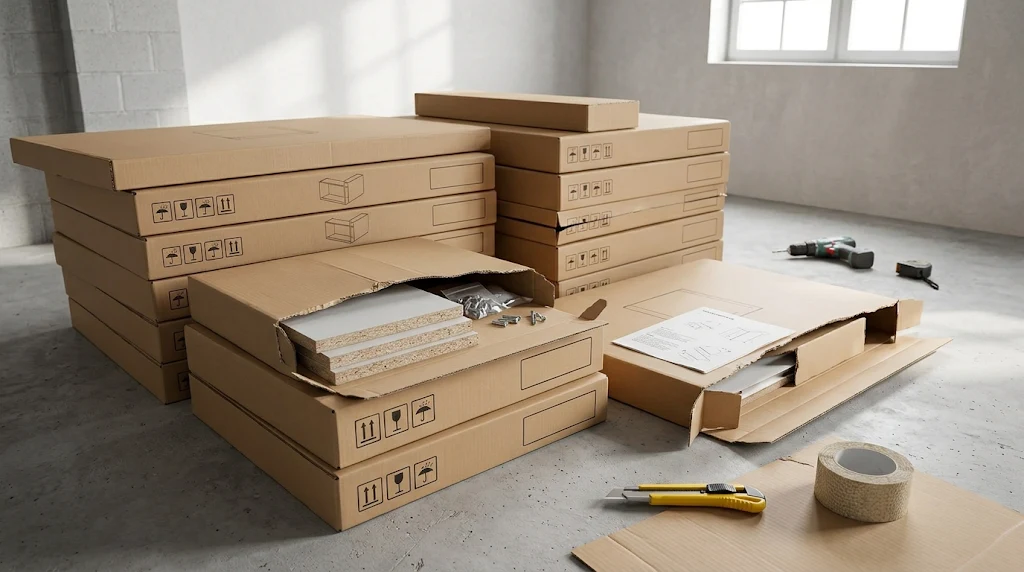
This Old House describes them as arriving “flat-packed in cardboard boxes with the hardware needed for assembly.” Most use screws, cam-lock hardware or angle brackets, so a screwdriver does most of the work. Angi adds that the doors, handles and frame pieces arrive as separate components.
They are not a lower material class by default. Lowe’s says both RTA and pre-assembled cabinets can use solid wood or engineered materials such as plywood and MDF, and Kitchen Cabinet Kings, a seller, says good RTA cabinets use the same materials, hardware and design as pre-assembled ones.
One practical point: parts come in many boxes. This Old House says one base cabinet’s parts often arrive in three or four boxes, so plan floor space.
Assembly: time, tools and skill
The sources do not agree on how long one cabinet takes, so treat any single figure with caution.
| Source | Time per cabinet | Notes |
|---|---|---|
| Kitchen Cabinet Kings (seller) | 10 to 20 minutes | About 2 to 4 hours for an average 10 x 10 kitchen |
| Lowe’s | 15 minutes for an expert DIYer; at least 45 minutes for a beginner | Quotes manufacturers for the 15 minutes |
| This Old House | 20 to 30 minutes | About 6 hours for 12 cabinets, plus unboxing and inventory |
| House Digest | About 30 minutes (manufacturer claim); closer to an hour for one author | Lists a cabinet jack, level, shims, stud finder and drill |
| Angi | About 45 minutes | Says to plan around 45 minutes to fully assemble each |
Example (our estimate): for a 12-cabinet kitchen, 20 to 45 minutes each is 4 to 9 hours of assembly (12 x 20 to 45 minutes). That is a long day or a short weekend, before installation. If you are new to this, plan toward the high end.
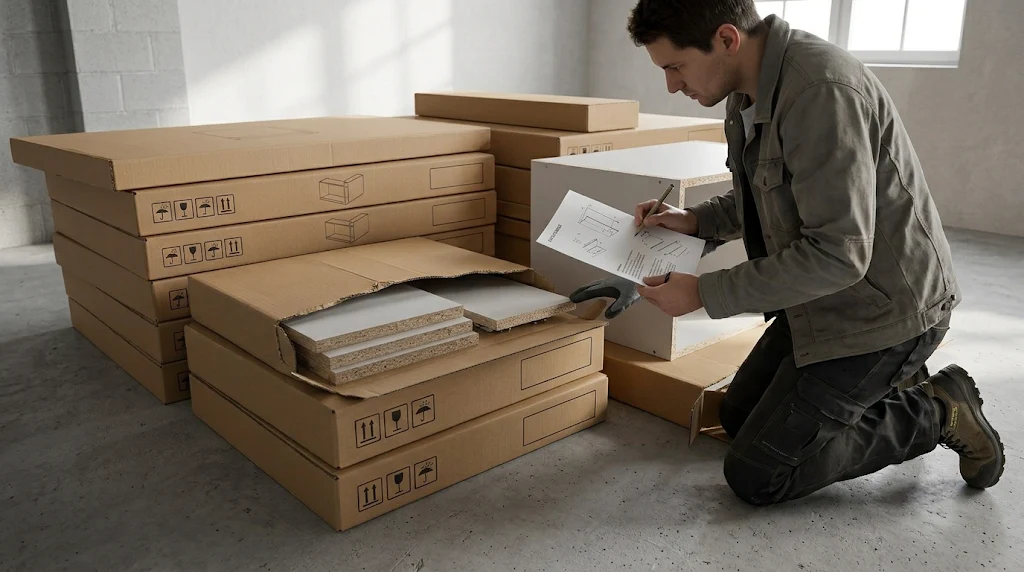
Tools matter more than skill, but accuracy matters. Today’s Homeowner lists beginners’ risks as misalignment or structural damage from assembly errors, and says a clean, flat work surface helps. House Digest notes that the buyer handles faulty parts, missing instructions and assembly mistakes. Once the boxes are built, installing cabinets once they are built is the next big step.
Quality: what to check
Quality in RTA kitchen cabinets is not one thing. These are the points the sources keep returning to.
| Part | What the sources suggest | Source |
|---|---|---|
| Box material | Plywood is generally better than particleboard; more plies mean sturdier plywood; ½ to ¾ inch is typical for stock | House Digest, This Old House |
| Cabinet backs | At least ⅜ inch thick, running the full height and length of the box | House Digest |
| Doors and frames | Solid-wood stiles and rails with an MDF panel or engineered slab is common; solid wood grips screws and hinges well | This Old House, CabinetSet |
| Drawer joints | Dovetail joints; thin drawer bottoms signal poor quality | House Digest, Kitchen Cabinet Kings |
| Slides and hinges | Undermount, full-extension, soft-close glides; six-way adjustable hinges; glides rated 75 pounds or more | This Old House |
| Finish | Thermofoil is common on the cheapest stock units; melamine and laminate are more durable; catalyzed-conversion varnish is the “gold standard” for stain or paint | This Old House |
| Fasteners | Cam locks can weaken a joint if screws go in crooked, especially in particleboard | Kitchen Cabinet Kings |
Material choice has trade-offs. House Digest says all pressed lumber releases some formaldehyde at very low levels, with MDF the most, and suggests ventilation. If emissions matter in your home, ask the seller for documentation.
Certification is another signal. KCMA says its certification program tests cabinets, including 25,000 door cycles, and Kitchen Cabinet Kings says most pre-assembled cabinets are KCMA certified. Ask whether the specific RTA line you are considering has been tested. For hardware, it also helps to know what soft-close hardware adds.
The honest limit: from a web page, you cannot see joints or finish. Order a sample door, and ask for the box material and drawer construction in writing.
What RTA cabinets cost
Prices for RTA kitchen cabinets vary, and savings claims vary widely, partly because sellers and publishers compare different products. Here is what each says.
| Source | Savings vs assembled | Price examples |
|---|---|---|
| This Old House | 30 to 50 percent lower; sometimes half | 10 x 10 kitchen (about 12 cabinets): $1,200 to $4,400 stock RTA; $7,000 and up custom RTA |
| Angi | Often about half | Pre-assembled $2,004 to $10,549; stock RTA about $1,000; custom RTA from about $7,000 |
| House Digest | “About 66% cheaper” (source’s claim) | 10 x 10 kitchen: $1,000 to $2,400 RTA vs $1,300 to $4,000 pre-built (Cost Owl estimate) |
| Kitchen Cabinet Kings (seller) | About 30 percent less | Pre-assembled starts at $70, $150 and $500 per linear foot (budget, mid, premium) |
| Kitchen Cabinet Kings guide (seller) | An average of 15 percent | 10 x 10 L-shaped: $1,200 to $4,400; one Shaker example $2,169 RTA vs $2,682 assembled |
The spread, 15 to 66 percent, is the honest answer. Compare quotes for the same material, door style and hardware, not just the headline price.
Example (our estimate): if an assembled set would cost $4,000, then at 30 to 50 percent savings the RTA version would run $2,000 to $2,800 (4,000 x 0.5 to 0.7). The $4,000 is an assumed figure, not a quote. Add shipping, filler strips, end panels and toe kicks, which sources say are often separate items.
Shipping and extras shift the math. House Digest says shipping is extra and to compare shipping costs, not only sticker prices. For wider pricing, see RTA, stock and custom prices compared.
Pre-assembled can win in one case. Kitchen Cabinet Kings says paying an installer to assemble RTA units can erase the savings, and Today’s Homeowner says hiring a pro to assemble raises the price significantly.
Warranty, delivery and damage
These are the surprises people regret most, so ask before you buy.
- Warranty. Sources differ. This Old House says a typical warranty is around five years, covering defects in materials and workmanship only. Kitchen Cabinet Kings says RTA cabinets have no warranty, and Angi says no warranty covers assembly mistakes. Get the actual terms in writing for the line you choose.
- Damage window. This Old House says to open every box within the first five days, since that is typically the window for reporting damage, and to photograph damage and note missing pieces. Check your seller’s own terms for how delivery and inspection work before the truck arrives.
- Replacement parts. House Digest says short shipping times do not help much if replacement parts take a month to arrive.
- Returns. Know what happens if a door is the wrong size. review returns before you buy, and read it in full.
- Storage. This Old House says to store cabinets away from extreme temperatures until you install them.
RTA or assembled?
Neither is better for everyone. Lowe’s says RTA suits budget-conscious people comfortable with basic tools, while pre-assembled suits those who want to cut project time or prefer factory assembly. It also says pre-assembled cabinets are built on a factory line, which supports consistent construction, while RTA quality depends on following the instructions carefully.
| Factor | RTA | Assembled |
|---|---|---|
| Price | Usually lower | Usually higher |
| Your time | Hours of assembly first | Go straight to installation |
| Shipping | Flat boxes, usually cheaper (Kitchen Cabinet Kings, Lowe’s) | Larger, costlier freight |
| Handling | Easy to carry in pieces | Heavy; two people to mount (Lowe’s) |
| Risk | Assembly mistakes are yours | Factory assembly |
If you want factory-built boxes, see how assembled cabinets arrive ready to hang. If you are leaning toward RTA, use the checklist below before you order.
What to check before buying
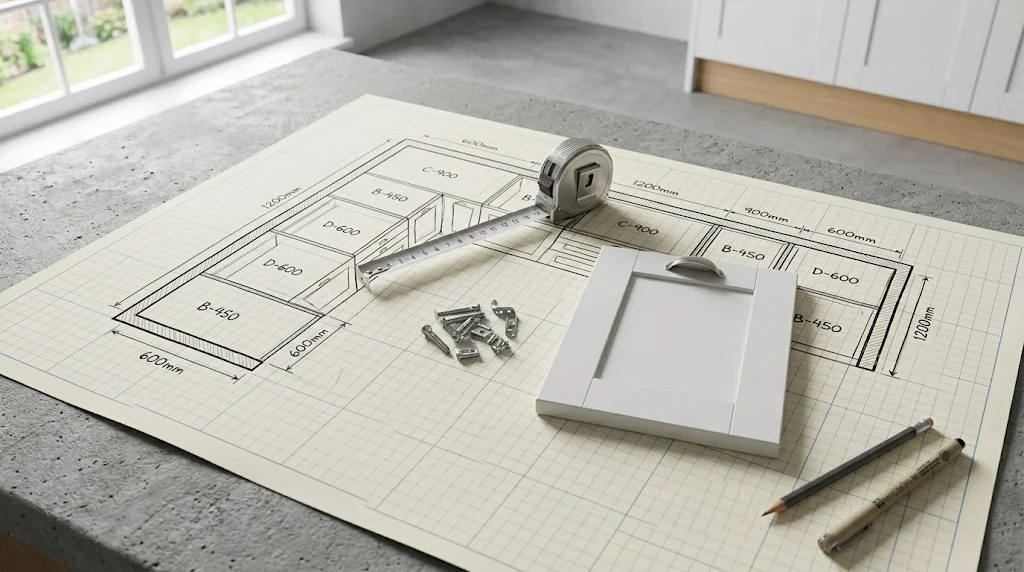
- Measure everything. This Old House says to map every upper and lower cabinet, filler strip and fixed item on graph paper. For a method, see how to map every wall and fixed item.
- Ask for specs in writing. Box material, back thickness, drawer joints, slide rating and hinge type, per the table above.
- Order samples. This Old House says to request sample doors or finished blocks to judge color and look.
- Price the extras. Fillers, end panels and toe kicks are often separate.
- Compare shipping. Cost, timing and who inspects what.
- Read the warranty and returns. Before you pay, not after.
- Plan the work. Space, tools, helpers and a few days. If your layout is complicated, get layout help before ordering.

Common mistakes and mental traps
- Choosing on price alone. A lower sticker price can hide thinner boxes, missing parts or shipping fees.
- Timeline optimism. “15 minutes a cabinet” is the best case. Beginners should plan on 45, per Lowe’s.
- The “while we’re at it” upgrade. Once you start adding pull-outs, soft-close extras and custom sizes, the savings can shrink. Set a limit first.
- Sunk cost. If a part arrives damaged or wrong, stopping assembly to sort it out is cheaper than building around it.
- Assembling before inspecting. Check every part first. Damage is easier to claim before it is built in.
- Trusting a single claim. Seller pages say what they sell. Cross-check with a neutral source.
Checklist
- ☐Measure the room and map every cabinet and filler
- ☐Get box material, back thickness and drawer joints in writing
- ☐Check slide and hinge specs, including weight rating
- ☐Order a sample door
- ☐Price shipping, fillers, end panels and toe kicks
- ☐Read the warranty, damage window and return terms
- ☐Open and inspect every box on delivery
- ☐Plan 4 to 9 hours of assembly for a 12-cabinet kitchen
Frequently asked questions
What are RTA kitchen cabinets?
They are cabinets that arrive flat-packed, with the hardware needed to assemble them, per This Old House. You build the boxes and then install them.
Are RTA kitchen cabinets good quality?
They can be. It depends on box material, joinery, hardware and finish, so ask for specifics. House Digest favors plywood over particleboard and dovetail drawer joints. Cheaper options vary, per Today’s Homeowner.
How long does it take to assemble RTA cabinets?
Sources range from 10 minutes to 45 minutes per cabinet. This Old House puts a 12-cabinet kitchen at about 6 hours, plus unboxing.
Are RTA cabinets cheaper?
Usually, by about 15 to 66 percent depending on the source. Compare like with like, and include shipping and extras. For delivery and ordering questions, find answers on ordering and delivery.
Do RTA cabinets come with a warranty?
It varies. This Old House says about five years for defects, while Kitchen Cabinet Kings says none. Always ask for the terms in writing.
Should I hire someone to assemble them?
You can, but Today’s Homeowner says this raises the price significantly, so compare against assembled cabinets before you decide.
Final thoughts
RTA kitchen cabinets can be a smart way to save money, as long as you are willing to spend a few hours, check the specs and read the fine print. They are not a gamble when you do that homework.
Write down what you need to confirm, then get it in writing. A few questions now cost far less than a wrong order later.
Comparing cabinets for your kitchen?
See available styles, or ask for help choosing between RTA and assembled.


