
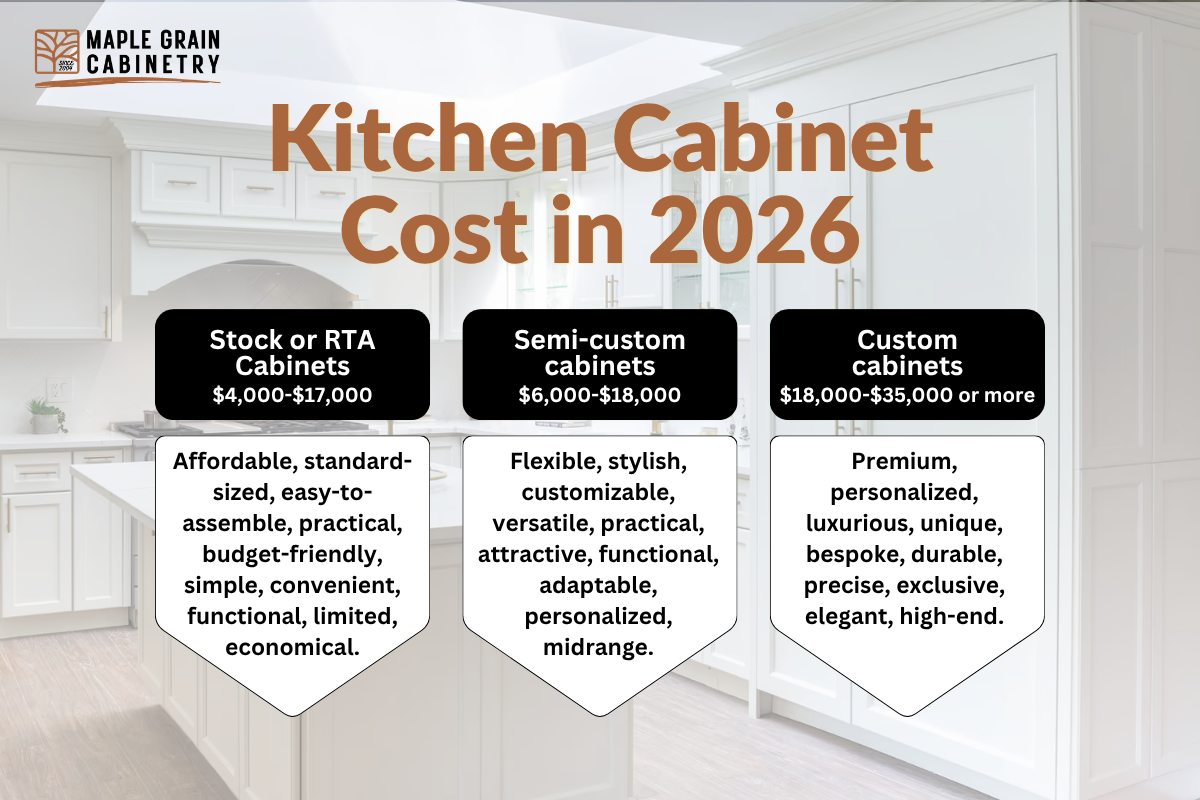
Picture the moment a cabinet quote lands in your inbox and you read the total twice. You are not alone. According to Angi, cabinets for a 10-by-10 kitchen can cost anywhere from $2,000 to $24,000, and most land between $4,000 and $13,000.
That gap is not random. It comes from how the cabinets are built and how much you can change them. Once you know the four common types, the numbers start to make sense, and you can plan a budget without feeling lost.
You do not have to decide today. A rough range, a measured wall length, and a short list of questions are enough for a first step.
Quick answer
Plan on about $100 to $300 per linear foot installed for stock cabinets, $150 to $650 for semi-custom, and $500 to $1,200 or more for custom, according to HomeAdvisor, Angi and HomeServe. RTA (ready-to-assemble) cabinets are published at roughly $80 to $250 per linear foot, depending on whether installation is included. Figures checked November 2026. Your local quote will differ.
What each type of cabinet costs per linear foot
A linear foot is the length of wall your cabinets cover, measured along the front. Most U.S. cost guides price cabinets this way, which gives you one number to multiply against your layout. The table pulls together ranges published by several guides, checked in November 2026.
| Type | Installed, per linear foot | Cabinets only, per linear foot | Sources |
|---|---|---|---|
| Stock | $100 to $300 | $50 to $100 | HomeAdvisor, Angi, HomeServe |
| RTA | $120 to $250 | $80 to $143 (see note) | Hunker, Family Handyman |
| Semi-custom | $150 to $650 | $75 to $400 | HomeAdvisor, Angi, HomeServe |
| Custom | $500 to $1,200 (some guides run higher) | $300 to $750 | HomeAdvisor, Angi, Hunker |
About the RTA row: Hunker lists RTA at $120 to $250 installed. Family Handyman gives roughly $80 to $143 per linear foot and does not say whether installation is included. One online retailer, NextDAY Cabinets, publishes a wider $100 to $300 in its 2026 guide. The spread is real, and it mostly reflects what each number includes and which product line is being priced.
Why are the ranges so wide? These are national averages built from contractor and retailer data, and several of the big cost sites draw on similar pools. Treat them as a planning band, not a quote. Labor also varies by region, which is why a local quote beats a national number every time.
To turn a per-foot range into a budget, you need your own wall length. Here is a step-by-step walkthrough for taking your own measurements before you start comparing.
What the four labels actually mean
The labels describe two different things, and mixing them up causes most of the confusion. Stock, semi-custom and custom describe how much you can change a cabinet. RTA describes how it ships and who builds the box.
- Stock: materials from the U.S. International Trade Commission describe stock cabinets as limited to standard sizes, with little customization and the lowest price point.
- Semi-custom: the same source describes them as made to order, priced above stock, with fewer options than custom. Fine Homebuilding notes they are built after you order, which is why they arrive later than stock.
- Custom: built to your dimensions and specifications. Angi points to oddly shaped kitchens and specific design needs as the usual reasons to choose it.
- RTA: flat-packed and delivered to you, according to Hunker. You or an installer assembles the boxes.

How do homeowners actually choose? The 2025 U.S. Houzz Kitchen Trends Study, as summarized by Woodworking Network, found renovating homeowners picking custom 45% of the time, semi-custom 32%, stock 12% and ready-to-assemble 9%. That survey reflects people active on Houzz, so read it as a snapshot of that group, not every household.
Where RTA cabinets fit in the price picture
RTA often shows up at the lower end of published ranges. Part of the trade is your time. You assemble the boxes yourself, or you pay someone to do it.
I could not find a reliable national figure for assembly labor on its own. If you plan to hire help, ask for that as a separate line before you assume the savings. For installation, the guides cited later give labor ranges you can use as a starting point.

It helps to look at the options side by side. If you want to see what a ready-to-assemble style looks like, one white Shaker RTA line is an easy place to start. If you would rather skip the building step, browse the pre-assembled options too.
Compare boxes, not just doors
A per-foot price tells you little about how a cabinet is built. Ask each seller to put the box material, drawer construction and hardware in writing, then compare those details. Product claims should come from the manufacturer or seller, not from a cost guide.
What moves the price inside each type
Two kitchens with the same wall length can still land far apart. These are the main levers, and each one is worth a conscious decision.
- Materials and finish. Angi separates materials from installed cost. For semi-custom, materials alone run about $75 to $400 per linear foot against $150 to $650 installed. For custom, it lists $300 to $750 for materials.
- Door mounting style. Angi says inset (flush) cabinets cost about 20% more than a similar traditional design with the same grade of materials.
- Drawers. Thumbtack, quoted by AOL, says a cabinet with many drawers costs more than a door-front cabinet, because each drawer is made separately.
- Layout complexity. Unusual walls and special storage push a project toward custom work, and custom sits at the top of every range above.
- Hardware and extras. Pulls, knobs and organizers are often priced apart from the cabinet. Ask what is included before you compare two totals.

Once you know your style, you can see the full range of styles and note which choices push the total up.
Costs that sit outside the cabinet price
The per-foot numbers above cover cabinets, and sometimes installation. A full budget needs a few more lines.
- Installation labor. Hunker says labor can run $50 to $250 per linear foot, set separately from materials. HomeServe quotes $80 to $190 per cabinet instead. Ask installers which method they use so you compare fairly.
- Delivery and freight. I did not find a reliable national figure. Each seller sets its own terms, so read the shipping and delivery policy and confirm costs before you order.
- Old cabinet removal and repairs. No reliable current national figure turned up. Ask contractors to list demolition and wall repair as their own line.
- Everything else in the kitchen. Countertops, flooring, appliances and lighting sit outside these cabinet ranges.
Tariffs and your quote
Trade policy can nudge cabinet prices. According to law firm Clark Hill, a 25% Section 232 tariff on imported kitchen cabinets, vanities and their parts took effect on October 14, 2025. A planned increase to 50% on January 1, 2026 was delayed by a proclamation signed December 31, 2025. STR Trade Report and Barnes & Richardson both report the higher rate is now scheduled for January 1, 2027.
These duties apply to imports, so how they show up in a shelf price depends on where a cabinet is made and how the seller handles the cost. Rates can differ by country of origin, and the rules can change quickly. Check the current status before you order.
When you compare sellers, ask where the cabinets are made and whether the quote already includes any duties. That one question can explain why two similar-looking offers differ.
General information, not advice
This is general information, not legal or trade advice. A customs broker or trade attorney can answer questions about a specific product or shipment.
How cabinets fit into your whole-kitchen budget
Cabinets are usually the biggest single line. This Old House says new cabinets make up at least a quarter of a typical kitchen budget, and an NKBA figure reported by Reviewed in 2022 puts the share at 29%. The same This Old House piece says a kitchen with about 17.5 linear feet of cabinets can average $25,000 or more to renovate.
For a wider anchor, NerdWallet reports that the 2025 Cost vs. Value report put an average minor kitchen remodel at $28,458. One retailer’s guide, from NextDAY Cabinets, treats a 10-by-10 kitchen as about 20 linear feet of cabinets (12 base, 8 wall), so I use that size below.
Example (our estimates): multiply 20 linear feet by the installed ranges from the table.
| Type | Installed range per foot | Estimated total for 20 feet |
|---|---|---|
| Stock | $100 to $300 | $2,000 to $6,000 |
| RTA | $120 to $250 | $2,400 to $5,000 |
| Semi-custom | $150 to $650 | $3,000 to $13,000 |
| Custom | $500 to $1,200 | $10,000 to $24,000 |
Notice how closely the stock-to-custom span matches Angi‘s $2,000 to $24,000 range for a 10-by-10 kitchen. For a 10-by-10 L-shaped layout with about 12 cabinets, This Old House puts stock RTA units at $1,200 to $4,400, which sits in the same neighborhood.
Small first action
Add up the length of your base and wall cabinet runs, then multiply by the low and high figure for the type you like. You now have a working range. You can also look through the resources section for the next step.
How long each type takes to arrive
Lead time depends on the product line, so published figures vary. These examples come from three sources, and the ranges overlap.
| Type | Typical lead time in the sources | Source |
|---|---|---|
| Stock | 1 to 4 weeks | Ringsend |
| Semi-custom | 4 to 7 weeks (one source), 5 to 6 weeks (another), 6 to 12 weeks (a third) | Ringsend, Houseplans, Cabinet IQ |
| Custom | 7 to 10 weeks, and 8 to 10 weeks for domestic custom lines | Ringsend, Houseplans |
RTA and assembled lines have their own timelines, which differ by seller. Read the terms for the specific line, and check the common questions about ordering before you plan around a date.
Here is a trap: people plan the whole project around the shortest number they saw. Plan around the long end, and order before demolition so your kitchen is not stuck without cabinets for weeks.
Which type fits your situation
| Your situation | Often a good fit | Why |
|---|---|---|
| Tight budget and comfortable building | RTA or stock | These sit at the lower end of the published per-foot ranges. |
| Standard layout, but you want finish and size choices | Semi-custom | Made to order with more options than stock, at a mid-range price. |
| Unusual walls, angles or special storage needs | Custom | Built to your dimensions, according to Angi, at the top of the price range. |
| You need cabinets soon | Stock or an in-stock line | Stock tends to have the shortest lead times in the sources above. Confirm with the seller. |

Still unsure? You can ask for layout help before you commit to a type or a budget.
Three money traps worth naming
- The “while we’re at it” upgrade. A pull-out here, an inset door there. Each looks small, but inset mounting, extra drawers and special features all add cost, as shown earlier. Set an upgrade cap before you shop.
- Sunk cost. After weeks of drawing a layout, it feels wrong to walk away from it. If the total is out of range, a simpler plan is a smart change, not a waste.
- Optimism about timelines. The shortest lead time is rarely the one you get. Build in buffer weeks and confirm dates in writing.
Myths vs. facts
| Myth | Fact |
|---|---|
| Custom always means better quality. | Custom means built to your specifications. Quality depends on materials and construction, so compare those details. |
| RTA is cheaper because it is lower quality. | RTA describes how a cabinet ships. Construction varies by line, so check the specs rather than guessing from the label. |
| Price per linear foot tells the whole story. | Some figures include installation and some do not, and finishes and hardware change the total. |
| The lowest quote is the best deal. | Two quotes can cover very different scopes. Line them up item by item first. |
Checklist before you request quotes
- ☐Total linear feet of base and wall cabinets
- ☐A target budget for cabinets as a share of the whole kitchen
- ☐Whether each price is installed or cabinets only
- ☐Box material, drawer construction and hardware, in writing
- ☐Where the cabinets are made and whether duties are in the price
- ☐Lead time in weeks and what event starts the clock
- ☐Delivery terms, inspection steps and the return policy
Frequently asked questions
How much do kitchen cabinets cost for an average kitchen?
It depends on type and size. Angi puts a 10-by-10 kitchen at $2,000 to $24,000, with most between $4,000 and $13,000. Your own number depends on linear feet, materials and local labor.
Are RTA cabinets cheaper than stock?
In the published guides, RTA often sits at or below the stock range per linear foot. The comparison changes if you hire out assembly, so price that step before you decide.
Is semi-custom worth it over stock?
It depends on how much you need to change. Semi-custom offers more options than stock at a higher price, according to the U.S. International Trade Commission materials cited above. If standard sizes fit your walls, stock may be enough.
When does custom make sense?
Angi points to oddly shaped kitchens and specific design needs. If your layout works with standard sizes, you may not need to pay custom prices.
Do tariffs make cabinets more expensive?
They can, for imported products. A 25% Section 232 tariff applies to imported cabinets, with a higher rate scheduled for January 1, 2027, according to the sources above. Ask each seller where its cabinets are made and what the quote includes.
How do I get an accurate quote?
Measure your walls, list the layout, and ask for itemized quotes from each seller or installer. A local contractor can confirm measurements and labor costs in your area. Prices and rules vary by state and city.
Final thoughts
Kitchen cabinet cost is not one number. It is a range shaped by type, materials, layout and labor, and your job is to find where you sit in it. Start with your linear feet, pick the type that fits how you live, and ask for itemized quotes.
Take your time. A calm, well-measured plan will serve you better than a rushed decision made under pressure. Recheck tariffs and lead times close to your order date, because both can change.
Ready to price your own kitchen?
Compare styles, then ask questions before you order.


