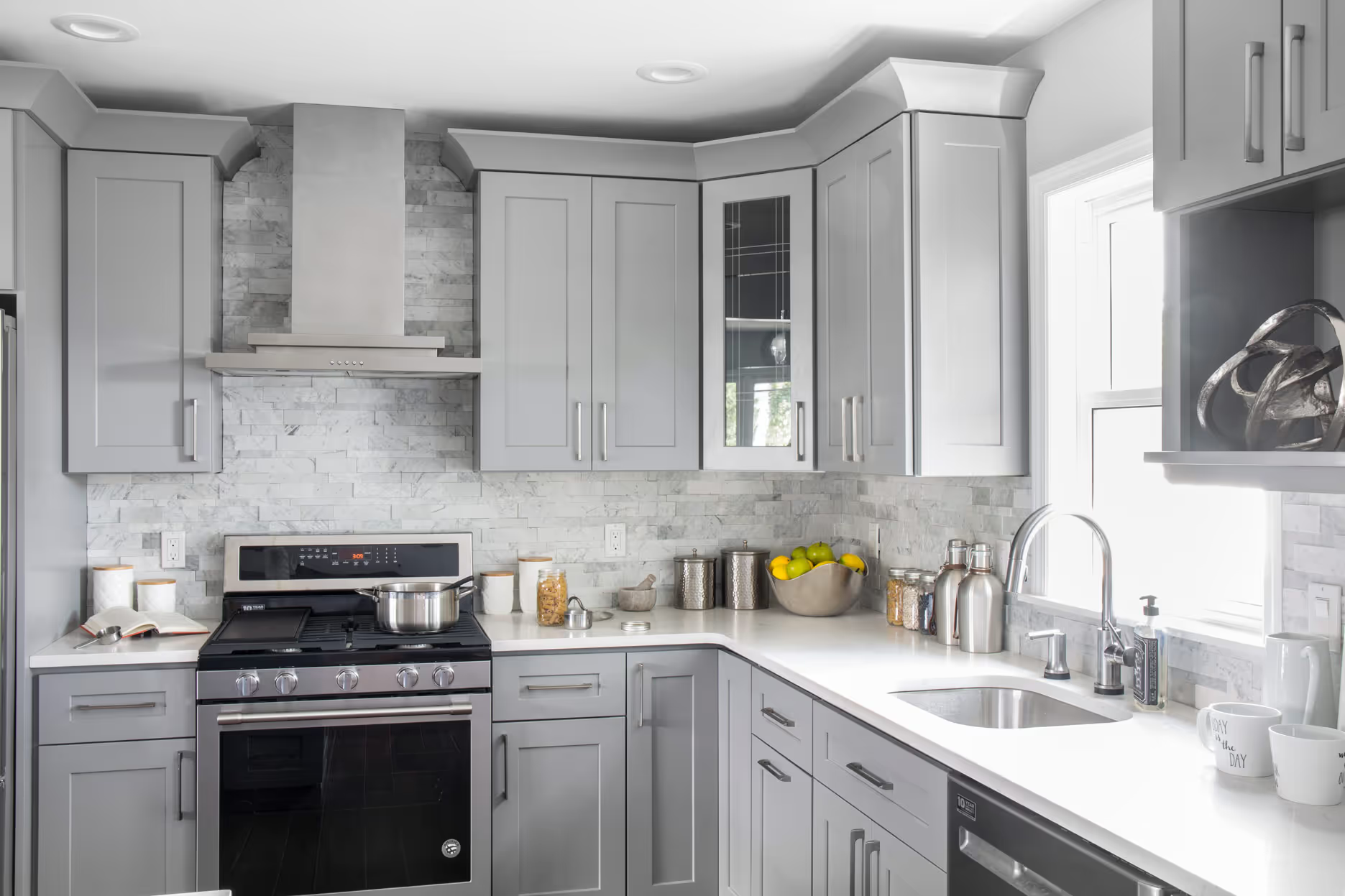
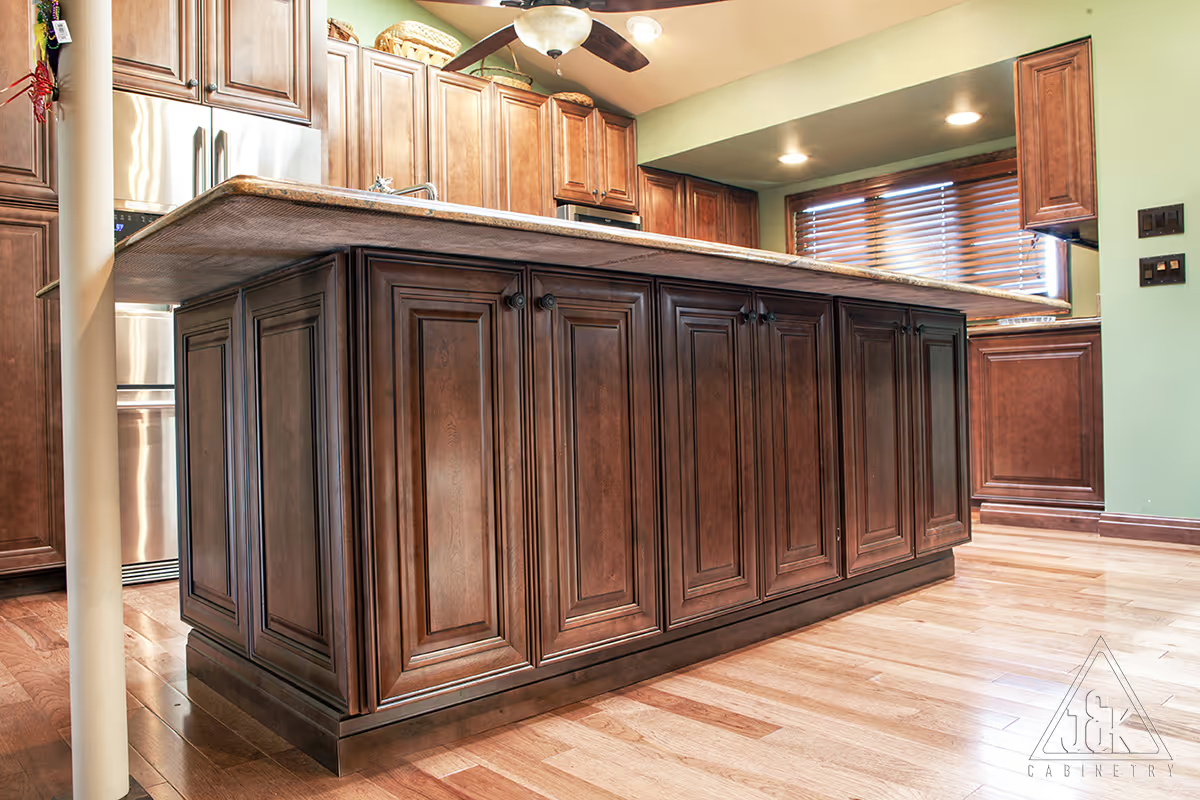
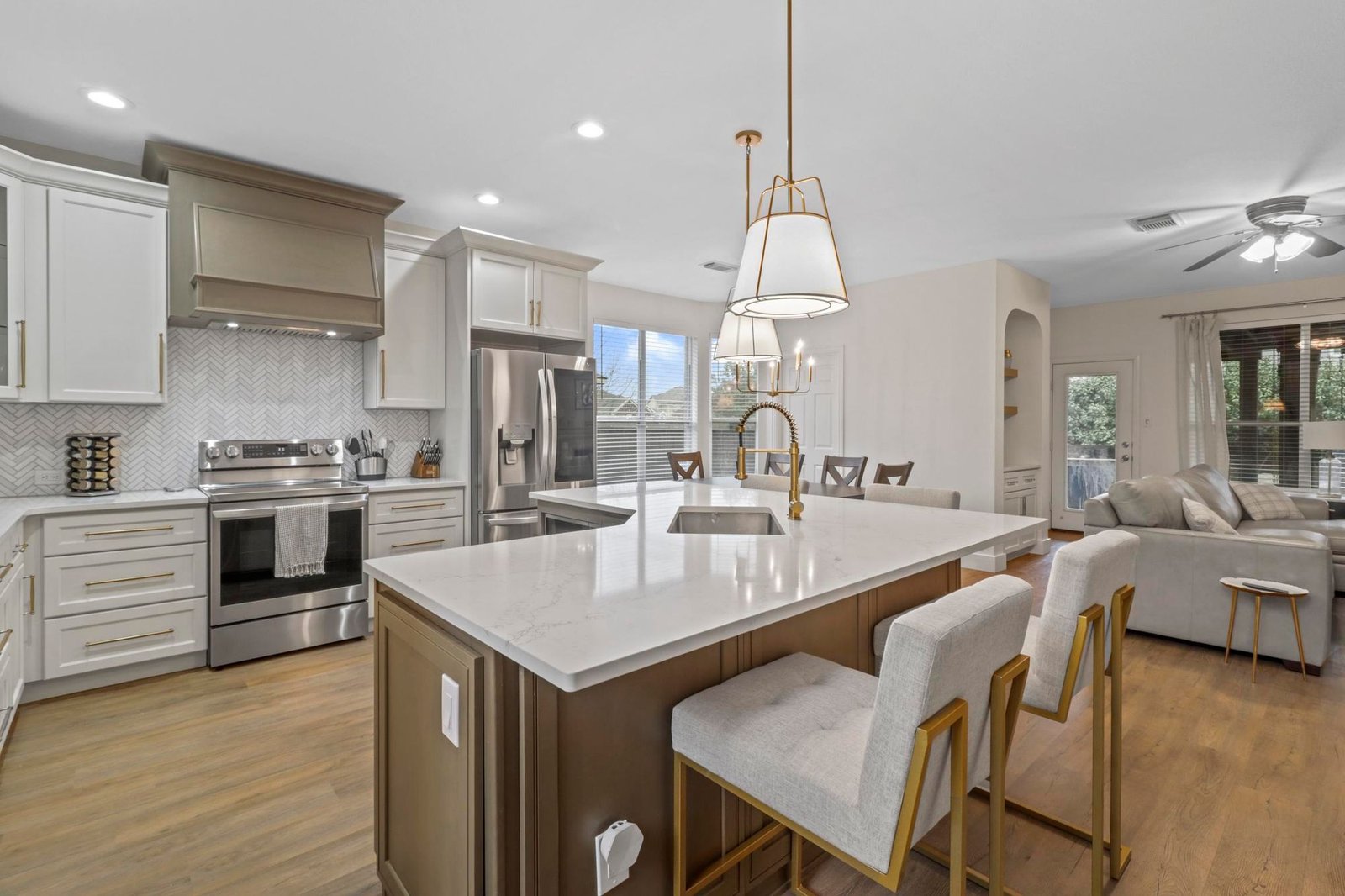
Hardware is the smallest part of your kitchen and the one your hands touch a hundred times a day. It is also easy to get wrong, because a pull that looked perfect in a photo can feel too small, too sharp or oddly placed once it is on a real drawer. These kitchen cabinet hardware ideas will help you choose with confidence.
The choices are not tiny to homeowners. According to the 2026 U.S. Houzz Kitchen Trends Study, 95% of renovating homeowners choose cabinets with handles, and bar pulls were the top pick at 74%. You do not have to follow the crowd, but it helps to know what the crowd is doing.
Below you will find the sizes, placement rules, finish options and costs, with the sources named so you can check them. Start with one drawer and one door, and the rest will follow.
Quick answer
Size a bar pull to about one-third of the drawer width, put every piece in the same spot on each door and drawer, and stick to two or three finishes at most. Pulls are easier to grip, and knobs look lighter. Hardware costs about $2 to $50 per piece, according to Angi. Test positions with painter’s tape before you drill. Figures checked November 2026.
What renovating homeowners actually choose
The 2026 U.S. Houzz Kitchen Trends Study surveyed 1,780 Houzz users in July 2025 and was released in January 2026, according to Houzz. Its hardware numbers are a useful snapshot, with the caveat that Houzz users are not every homeowner.
| Hardware choice | Share of renovating homeowners |
|---|---|
| Bar pulls | 74% |
| Knobs | 37% |
| Cup pulls | 10% |
| Finger pulls | 9% |
| Brushed nickel finish | 28% |
| Black finish | 18% |
| Brushed gold finish | 12% |

The handle types add up to more than 100%, so plenty of kitchens clearly use more than one type. That fits a common design move covered next: knobs in one place and pulls in another.
Pulls vs. knobs
Neither is better in every kitchen. San Diego Hardware says knobs are small and subtle, which suits cabinetry you want to show off, while pulls are easier to grip for people with weak or arthritic hands, keep hands off the cabinet surface and come in more designs.
- Pulls everywhere. A clean, consistent look, and a practical one for heavy drawers.
- Knobs on doors, pulls on drawers. KraftMaid suggests this mix, and the same guide also suggests knobs on wall cabinets with pulls on base cabinets.
- Knobs everywhere. A lighter look that suits smaller kitchens and simple door styles. Kitchen Cabinet Kings, a retailer, says simple round knobs still look current.
San Diego Hardware adds that neither mix is superior, so go with what feels good in your hand. Open and close a few options in a showroom or from a sample order before you commit.
How to size pulls and knobs
Three sources give the same simple rule for pulls. Top Knobs says a bar pull should not exceed one-third of the width of a drawer. KraftMaid says a pull should be about one-third as wide as the drawer face, so a 4-inch pull is ideal on a 12-inch drawer. Plank Hardware gives the same one-third rule.
Top Knobs also publishes length ranges by door height and drawer width. Pull sizes below are measured center-to-center unless noted.
| Cabinet part | Suggested pull size | Source |
|---|---|---|
| Doors under 24 inches tall | 3 to 7 inches | Top Knobs |
| Doors 24 to 36 inches tall | 7 to 12 inches | Top Knobs |
| Doors over 36 inches (pantries, built-ins) | More than 12 inches | Top Knobs |
| Drawers under 16 inches wide | One 3 to 5 inch pull, centered | Top Knobs |
| Drawers 16 to 32 inches wide | Two 5 to 7 inch pulls or one 9 to 12 inch pull | Top Knobs |
| Drawers over 32 inches wide | A pull longer than 12 inches | Top Knobs |
For knobs, Top Knobs says standard sizes run 1 to 2 inches in diameter and suit doors of any size, and San Diego Hardware says 1 1/4 inches is always a safe bet. Make sure the knob is not wider than the frame of the door it mounts to, as KraftMaid advises.
When you land between two sizes, San Diego Hardware says to size up. That same guide suggests choosing pulls with at least a 3 3/4 inch center-to-center spacing for a comfortable grip. For very wide drawers, you can choose two pulls instead of one long one, as covered in the placement section.
Center-to-center, explained
Pulls are sold by center-to-center (often shortened to c-c), which is the distance between the two screw holes, according to Plank Hardware and Top Knobs. Overall length is a different number. A pull can be longer than its c-c spacing, so read the product page carefully.
- Replacing old hardware? Measure from the center of one screw hole to the center of the other, as Plank Hardware describes. Match that number so the new pull covers the old holes.
- Metric sizes. Plank Hardware calls 96 mm and 128 mm the most commonly specified pull sizes for standard kitchen cabinets. By our conversion, that is roughly 3 3/4 inches and 5 inches.
- Changing sizes? A different spacing means new holes and some filling of the old ones. Ask a cabinet pro whether your finish can be repaired cleanly.

Where to place hardware
Consistency matters more than any single rule. Angi says to place every knob and handle at exactly the same spot on each door or drawer.
Doors
- Framed doors. KraftMaid describes a traditional placement at the intersection of the middle of the vertical stile and the horizontal rail. Hunker says to center pulls on the stile and set them about 2 to 4 inches up from the bottom on upper doors, or 2 to 4 inches down from the top on lower doors.
- Slab doors. KraftMaid says 2 to 3 inches from both edges. Angi says about one inch from the edge, in the top third to quarter of the door. San Diego Hardware says holes equidistant from the bottom and side edges, with 2 inches typically a good distance.
- Glass-panel doors. Angi says to center the hardware on each glass panel, or place it at the mullion intersections.
Drawers
- One piece. Center it left to right. Hunker says to move it slightly toward the top, since dead center can look low, and KraftMaid offers a choice between full centering and a consistent 2 to 3 inches from the top.
- Wide drawers. Angi says to use two pulls or one long handle on drawers 24 inches wide or more. For two pulls, divide the drawer into thirds and center a pull in the left and right sections. KraftMaid also uses thirds, but centers each pull on the dividing lines instead.
| Where the guides differ | What the sources say | How to handle it |
|---|---|---|
| Slab door edge distance | KraftMaid: 2 to 3 inches from both edges. Angi: about 1 inch from the edge. | Mock up both on one door and pick the one that looks balanced in your room. |
| Where two pulls sit | Angi: in the center of the left and right thirds. KraftMaid: on the two lines that divide the drawer into thirds. | Tape both layouts and check how they look against the drawer edges. |
| When to use two pulls | Angi: at 24 inches wide or more. Top Knobs: two 5 to 7 inch pulls for 16 to 32 inch drawers, or one 9 to 12 inch pull. | Treat these as options, not rules. Either one can look right. |
Mock it up first
Angi suggests marking positions with painter’s tape and a pencil, and Hunker suggests holding a knob in place with poster putty and stepping back to judge it. Both recommend a template once you decide, so every hole lands in the same spot.
Choosing finishes
In the Houzz study, brushed nickel led at 28%, then black at 18% and brushed gold at 12%. Those three give you a quick map of what is common right now.
Kitchen Cabinet Kings, a cabinet retailer, notes warm metals such as champagne bronze and aged brass, matte black for contrast, and polished nickel as a bright classic. It cites no survey for these, so treat them as one retailer’s observations rather than market data.
Mixing metals without chaos
- Kitchen Cabinet Kings suggests sticking with two main finishes, or three at most, and repeating each more than once so nothing feels random.
- Pick one lead finish for the cabinet hardware and a secondary one for the faucet, lighting or accents.
- Your hardware does not have to match your faucet, according to the same source. It just needs to look intentional.

Look at finish samples in your own kitchen light, next to your countertop and flooring, before ordering a full set. Screens and showroom lighting can change how a metal reads.
Kitchen cabinet hardware ideas by cabinet style
If you are still deciding, here are kitchen cabinet hardware ideas drawn from the sources. They are ideas, not rules. For a feel for door styles, you can compare cabinet door styles on the site.
- Shaker doors. Plank Hardware suggests D-bar pulls in the 96 to 128 mm center-to-center range. A white Shaker door, like a white Shaker style, pairs well with simple bar pulls or knobs.
- Slab or modern doors. Kitchen Cabinet Kings lists oversized and linear pulls on wide drawers and pantry doors as a current look. Top Knobs says appliance pulls come in sizes from 12 to 30 inches for doors and drawers over 36 inches.
- Traditional doors. Top Knobs says cup pulls usually go at the top center or center of drawers. Kitchen Cabinet Kings mentions cup pulls, glass knobs and ceramic details in simpler forms.
- Glass-front doors. Center the hardware on each glass panel or at the mullion crossings, per Angi.
- A mixed look. Knobs on doors and pulls on drawers keeps the hardware varied without looking busy.

Comfort and ease of use
Think about the people who use the kitchen every day. According to Mockett, there are currently no official ADA regulations specifically governing cabinet handles or pulls, so what follows is that company’s own design guidance rather than a legal standard.
- Hardware should be operable with one hand and should not require tight grasping, pinching or twisting of the wrist.
- Rounded or gently contoured shapes are preferred over designs that need precise pinching.
- Pulls should leave a minimum of 7/8 inch of clearance between the pull and the surface so fingers fit, and the inner length should be at least 3 1/4 inches.
This lines up with San Diego Hardware, which says pulls are easier to grip for people with weak or arthritic hands. If you are designing for a specific accessibility need, or for a rental or commercial space, check your local requirements and ask a professional. This is general information, not advice.
What cabinet hardware costs
Hardware is a small line in a kitchen budget, but the spread is wide. Angi says cabinet hardware averages $2 to $50 each, with material making a big difference.
| Material | Price per piece (Angi) |
|---|---|
| Plastic | $1 to $5 |
| Wood | $1 to $10 |
| Glass | $3 to $25 |
| Stainless steel | $4 to $32 |
| Zinc alloy | $5 to $100 |
| Brass | $5 to $200 |
For installation, Angi lists $5 to $30 per piece from a remodeling professional, or $50 to $100 per hour for a handyperson, with an average installation taking about three hours. For an average kitchen of 100 to 200 square feet (20 to 40 pieces), Angi estimates $120 to $2,400 in total, including labor.
Example (our estimate): 30 stainless steel pieces at $4 to $32 each comes to about $120 to $960 for the hardware alone. Plan the same count for a fancier finish and the total can climb fast, which is why it pays to count your pieces first.
Hardware is only one line of the full project. For the cabinets themselves, read where hardware fits in the cabinet budget, and if you plan to hang cabinets yourself, see the full cabinet installation walkthrough.
Common mistakes and mental traps
- Buying for the photo. A pull that looks great in a picture may be the wrong scale for your drawer. Use the one-third rule and tape a paper cutout to the drawer.
- The “while we’re at it” upgrade. Moving from a $4 piece to a $40 one looks like a small step, but across 30 pieces it adds up. Set a per-piece cap before you shop.
- Drilling before testing. Holes cannot be unmade. Once you have drilled, you have also locked in your choice, so the sunk-cost feeling kicks in. Mock up first.
- Mixing too many finishes. Stick to the two or three finish limit from earlier so the room feels planned.
- Ignoring c-c. If you replace hardware, measure the existing holes before ordering. Ordering by length alone is a common trap.
Checklist before you order
- ☐Count every door and drawer, and decide one or two pieces per drawer
- ☐Measure drawer widths and door heights, then apply the one-third rule
- ☐Check center-to-center if you are replacing hardware
- ☐Pick one lead finish and one or two supporting finishes
- ☐Order samples and test them in your own light
- ☐Tape up positions and step back before drilling
- ☐Use a template so every hole matches
Frequently asked questions
Should I choose knobs or pulls for kitchen cabinets?
Either works. Pulls are easier to grip, according to San Diego Hardware, and bar pulls were the top choice in the Houzz study. Knobs read as lighter. Many kitchens mix them, with knobs on doors and pulls on drawers.
What size pull should I use on a drawer?
A common rule is about one-third of the drawer width. Top Knobs lists a 3 to 5 inch pull for drawers under 16 inches wide, and either two 5 to 7 inch pulls or one 9 to 12 inch pull for 16 to 32 inch drawers.
How far from the edge should a knob or pull go?
It depends on the door style. For slab doors, KraftMaid says 2 to 3 inches from both edges, while Angi says about one inch from the edge. Test both with tape.
Do my cabinet pulls need to match my faucet?
No. Kitchen Cabinet Kings says your hardware does not have to match your faucet, as long as the mix looks intentional and you limit yourself to two or three finishes.
How much does it cost to replace kitchen cabinet hardware?
Angi puts hardware at $2 to $50 per piece, with $5 to $30 per piece for professional installation. For 20 to 40 pieces, it estimates $120 to $2,400 including labor. If you are buying cabinets too, you can read answers to buying questions on the site.
Final thoughts
The best kitchen cabinet hardware ideas come down to scale, consistency and a little testing. Size pulls to the drawer, keep placement the same everywhere, and choose a finish plan you can repeat around the room.
If you are not sure where to start, a second set of eyes can help. You can get a second opinion on your plan before you order or drill anything.
Ready to plan your cabinets?
Compare styles, then ask for help with hardware and layout before you order.