1621 Southridge Trail
Algonquin IL 60102
+312 617 2668
24/7 Customer Support On Line
Mon - Fri: 9:00 - 18:00
Online store always open
Algonquin IL 60102
24/7 Customer Support On Line
Online store always open
Choosing between RTA vs assembled kitchen cabinets is one of the biggest decisions in a kitchen remodel. One option saves you money if you are willing to do some of the work. The other costs more, but it arrives ready to hang.
Neither option is always better. The right choice depends on your budget, your timeline, and how comfortable you are with a power drill. This guide compares both on cost, quality, lead time, labor, and more, so you can decide with confidence.
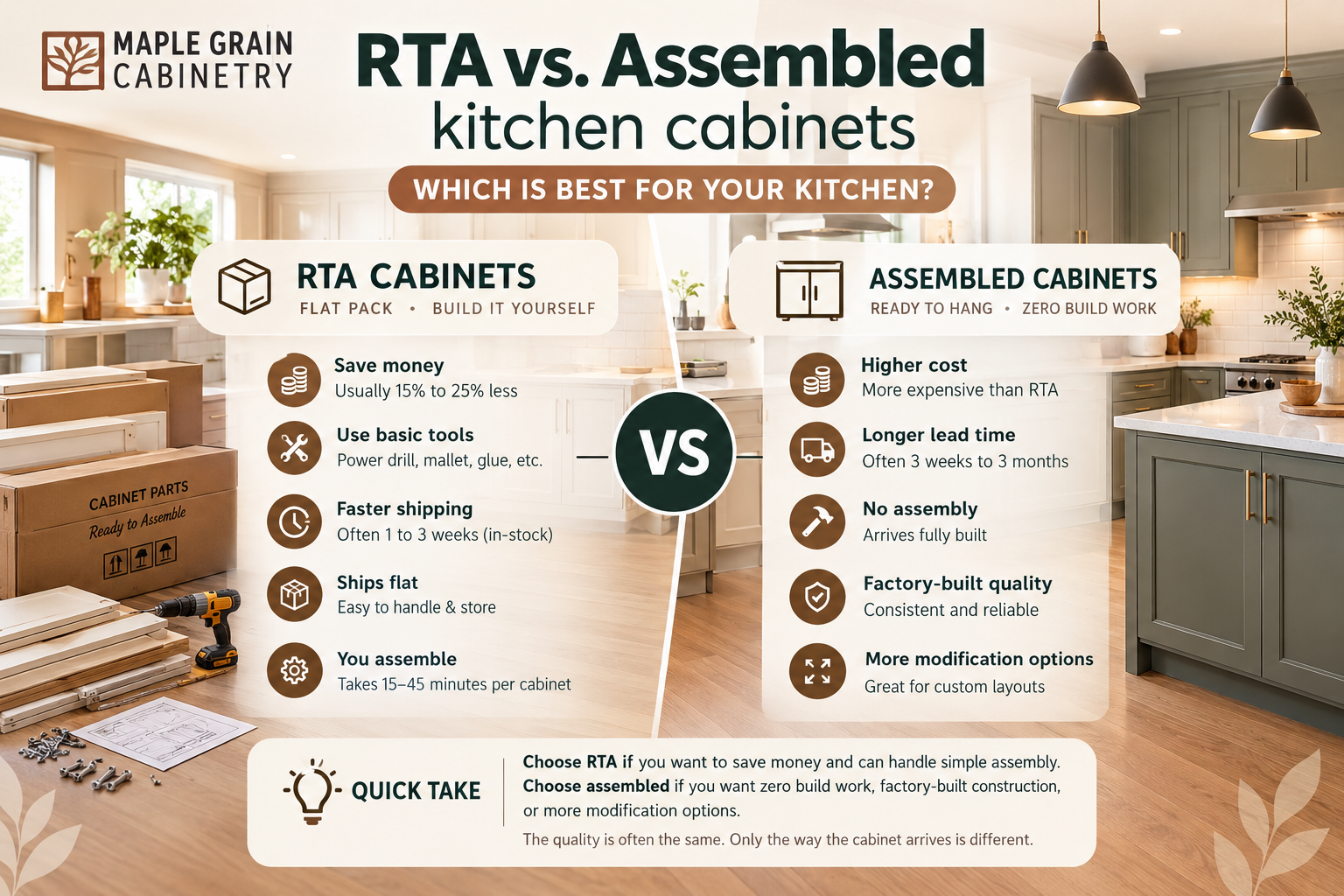
Choose RTA if you want to save about 15% to 25% and can handle simple assembly. Choose assembled if you want zero build work, factory-built construction, or more modification options. The quality is often the same. Only the way the cabinet arrives is different.
RTA stands for ready-to-assemble. The cabinets ship flat in boxes. Each box holds the panels, doors, drawer fronts, hardware, and instructions. You or your contractor build them on site.
You only need basic tools: a power drill, a rubber mallet, wood glue, a square, and clamps. Most RTA lines use cam-lock or screw-and-dowel joints. Both are easy to learn.
The first cabinet takes 30 to 45 minutes while you learn the system. After that, a standard base or wall cabinet takes about 15 to 30 minutes. A full 10x10 kitchen takes one person about a weekend, or a crew a few hours.
RTA is also a fast-growing part of the US cabinet market. Many buyers now prefer to order direct and online instead of shopping in a showroom, mostly because of the lower price.
Assembled cabinets, also called pre-assembled cabinets, arrive fully built. The factory joins the boxes with glue and screws, attaches the hinges, and fits the doors and drawers. You only need to level them, join them, and mount them to the wall.
Because the factory builds them with industrial equipment, the build is consistent. You unpack them and start installing right away.
When a cabinet line comes in both formats, you are usually not choosing between two different products. You get the same plywood box, the same dovetail drawers, and the same soft-close hinges. The only difference is who does the final assembly.
Here is a quick view of the factors that matter most. Each one is explained in detail below the table.
| Factor | RTA cabinets | Assembled cabinets |
|---|---|---|
| Price | About 15% to 25% lower | Higher |
| Lead time | Often 1 to 3 weeks for in-stock lines | Often 3 weeks to 3 months. In-stock lines can ship fast |
| Assembly | You or your contractor build each box | None. Ready to hang |
| Labor cost | $0 if you do it. About $50 to $100 per cabinet if you hire it out | No assembly labor |
| Quality | Same as assembled when the line is the same. Depends on your assembly | Factory-built, consistent |
| Shipping | Flat boxes. Easy to handle | Bulky. More pallets |
| Storage on site | Small boxes stack in a corner | Needs more floor space |
| Modifications | Usually limited | Usually more options |
| Best for | DIYers, budget projects, contractors | Hands-off projects, custom layouts |
RTA cabinets usually cost 15% to 25% less than assembled cabinets from the same line. On a kitchen that costs $6,000 assembled, that is about $900 to $1,500 in savings.
Why RTA costs less
If you pay an installer $50 to $100 per cabinet to build RTA boxes, a 14-cabinet kitchen adds $700 to $1,400. That can wipe out most or all of the discount. RTA saves real money when you or your own crew do the assembly.
Here is how that looks on a kitchen with 14 cabinets and a $6,000 assembled price:
| Scenario | Result |
|---|---|
| You assemble the RTA boxes yourself | Save $900 to $1,500 |
| You hire someone to assemble them | Between $800 saved and $500 extra cost |
Buying for several jobs? Ask about trade or quantity pricing. It can lower the price of both RTA and assembled cabinets. Maple Grain offers quantity discounts for commercial buyers.
In-stock RTA lines often ship in 1 to 3 weeks. Some lines with large inventories ship in 5 to 7 business days. Flat packs fit on one or two pallets, so freight is cheaper and delivery is easier.
Assembled cabinets often take 3 weeks to 3 months, depending on the maker. They need more pallets and more careful handling. Some in-stock assembled lines still ship in under 7 days.
At Maple Grain, processing takes up to 5 business days, and delivery follows within 7 business days. Assembled cabinets and orders with modifications have a 2-week lead time.
If speed matters, check the stock status of the exact line you want. RTA is faster more often, but not always.
This is where the decision becomes personal. Assembled cabinets need no build step, so installation starts on day one. RTA cabinets need a build step first.
RTA assembly time
How RTA assembly works
If you or a free helper assemble the boxes, RTA saves money. If you pay by the hour or by the box, run the numbers first. Hourly billing means you also pay for the assembly time.
Many people do not realize this: RTA and assembled cabinets from the same manufacturer are often the same product. The only difference is whether the factory builds the box or you do. So the quality is not better or worse because of the format. Always compare construction details instead. These three matter most:
One caveat: your assembly skill
With RTA, the final quality depends on how well you build the cabinet. Overtightening screws or cams can damage a panel. Panels that do not line up can leave doors uneven. Most warranties cover manufacturing defects, not assembly mistakes, so read the warranty before you buy.
In short: professionals assemble factory-built cabinets, while RTA cabinets depend on your skill.
Assembled cabinets are bulky. Corners can dent and doors can shift during shipping. On site, they take up floor space and can be hard to move through narrow hallways or small elevators.
RTA boxes are compact and protected by tight packaging. You can stack them in a corner until you are ready. The trade-off is that you must check for missing or damaged parts.
Count the boxes, check them against the packing list, and note any damage on the delivery receipt before the driver leaves. Do this for both formats.
Assembled lines often offer more factory modifications. Examples are depth changes, glass-ready doors, glaze upgrades, and finished side panels. RTA lines usually offer fewer options.
If your kitchen has unusual sizes or needs custom touches, assembled or semi-custom lines give you more flexibility.
Your budget, timeline, DIY skills, and need for convenience decide this. Use the lists below to see which side fits you.
| Choose RTA cabinets if: | Choose assembled cabinets if: |
|---|---|
| You want to save money. RTA costs less because you do the assembly. | You do not want to assemble anything. They arrive built. |
| You can use basic tools and have a free weekend. | Your schedule is flexible. You can wait longer for convenience. |
| You are a contractor buying for several projects. | Your contractor bills by the hour. Paid assembly can cancel your RTA savings. |
| You need cabinets quickly. In-stock RTA lines often ship in 1 to 3 weeks. | You need modifications, such as a different depth or glass-ready doors. |
| Storage space is tight before install. Flat packs take less room. | You want the factory to stand behind the build and assembly quality. |
| It is a high-end kitchen and you value time and a finished result over savings. |
Answer these three questions to get your direction.
| Question | If yes | If no |
|---|---|---|
| Can you or a free helper build the boxes? | RTA will likely save you money | Price the labor first, then compare |
| Do you need special sizes or modifications? | Look at assembled or semi-custom lines | Either format works |
| Do you need the cabinets soon? | Check in-stock RTA lines first | Either format works |
Maple Grain Cabinetry sells solid wood kitchen cabinets in both formats and ships across the US. You can browse each style as RTA kitchen cabinets or assembled kitchen cabinets. Pick the look first, then choose the format that fits your budget and schedule.
Contractors, hotels, hospitals, and offices can ask about quantity pricing. Not sure which format fits your project? Contact our team and we will help you compare.
No. When both formats come from the same line, they are often the same cabinet. One ships in pieces and the other ships built. Quality depends on the box material, drawer construction, and hardware, not on who does the final assembly.
Typically 15% to 25% compared with the assembled version of the same line. On a kitchen that costs $6,000 assembled, that is about $900 to $1,500. Hiring someone to assemble the boxes can reduce or remove this saving.
A power drill, a rubber mallet, wood glue, a square, and clamps. No special tools are needed. Many lines use cam-lock joints, which are easy for first-time builders.
Yes. Many companies and handymen offer assembly. Expect to pay about $50 to $100 per cabinet. Get the price in writing before you order.
Replacement panels are usually available to buy. Damage caused during assembly is usually not covered by the warranty, but parts are often low in cost. Read the warranty before you order.
No. Once an RTA cabinet is built, installation is the same as for an assembled cabinet. You level it, join it to the next cabinet, and mount it to the wall.
The choice between RTA and assembled cabinets is not about which is better. It is about which suits your situation. If you are willing to put in some sweat equity, RTA gives you the same product for less money. Assembled cabinets cost more, but they save time and remove the assembly step.
If you are a DIY fan or a budget-focused contractor, RTA is an excellent choice. If you want a hassle-free project and your budget allows, assembled cabinets give you convenience without lowering quality.
Either way, you get real wood cabinets that can transform your kitchen. The final decision comes down to what you value more: your money or your time. Browse Maple Grain kitchen cabinets in RTA or assembled.